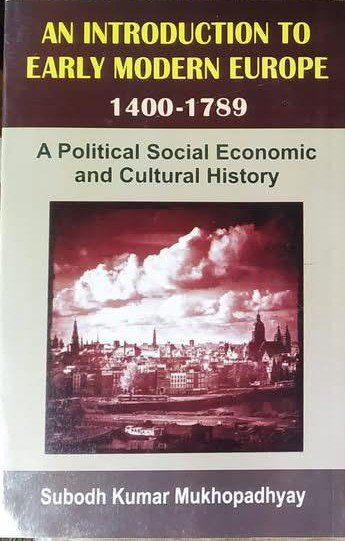


AN INTRODUCTION TO EARLY MODERN EUROPE 1400-1789
AN INTRODUCTION TO EARLY MODERN EUROPE 1400-1789
A Political Social Economic and Cultural History
Subodh Kumar Mukhopadhyay
An Introduction to Early Modern Europe 1400-1789, a political social economic and cultural history, unfolds the story of emergence of modern Europe in all its aspects. It was the age of the Renaissance, Art and humanism, of printing revolution and military technology. The breakdown of the universal empire was followed by the growth of national states with strong army, bureaucracy, judiciary and tax system: The renaissance monarchs were absolute rulers The absolutist state was first challenged and then overthrown in England, it was the age of commercial expansion and price revolution. It was the age of geographical discoveries and colonial empires. Europe got rid of its insularity and became globalised. In the age of globalisation Europe was thoroughly transformed. Feudalism declined and its place was taken by capitalism. The Reformation was able to break the monolithic control of the Roman Catholic Church. The new ideal of the new age was religious toleration, Locke being the exponent of the new thinking. The Industrial revolution and the American war of independence were other two important events of the age, the latter strengthened the idea of republicanism and the former changed the system of production, virtually a new Europe was bom
-------------------------------------
Dr. Subodh Kumar Mukhopadhyay was professor of History in the West Bengal Senior Education Service. In his early life he served 'St. Paul's College, Calcutta, A. B. N. Seal College, Cooch Behar, Chandemagore Government College, Krishnanagar Govt College and Presidency College, Calcutta. He retired as professor and Head of the Department of History, Hooghly Mohsin College Chinsurah, West Bengal. So far he has authored fourteen books two of which are in English. He has written a few stray articles in different journals and attended several state and national level seminars. Dr. Mukhopadhyay is still actively engaged in research.

-
 ₹372.00
₹400.00 -
₹100.00
-
₹368.00
₹400.00 -
₹295.00
₹320.00




সংশ্লিষ্ট বই

বই সংক্রান্ত জিজ্ঞাসা (0)
প্রবেশ করুন বা রেজিস্টার করুনআপনার প্রশ্ন পাঠানোর জন্য
অন্যান্য প্রশ্নাবলী
কেউ এখনো কোন প্রশ্ন জিজ্ঞাসা করেননি
-
₹372.00
₹400.00 -
₹100.00
-
₹368.00
₹400.00 -
₹295.00
₹320.00